Children's Rights
Children have rights that must be respected. Children and young adults aged 6-16 must get primary education.
Parents are obliged to protect their children from violence and other threats.
Children´s rights and responsibilities
Children have the right to know both of their parents. Parents are obliged to protect their children from mental and physical violence and other threats.
Children should receive education in line with their abilities and interests. Parents should consult their children before taking decisions that affect them. Children should be given a greater say as they grow older and become more mature.
Most accidents involving children under the age of 5 occur inside the home. A safe environment and parental supervision greatly reduce the chance of accidents in the first years of life. To prevent serious accidents, parents and others who care for children need to know the relationship between accidents and the physical, mental, and emotional development of children at each age. Children do not have the maturity to assess and deal with dangers in the environment until the age of 10-12.
Children aged 13-18 should obey the instructions of their parents, respect the opinions of others and observe the law. Young adults acquire legal competence, that is the right to decide their own financial and personal affairs, at the age of 18. This means that they are responsible for their own property and can decide where they want to live, but they lose the right to maintenance by their parents.
Children aged 6-16 must attend primary education. Compulsory school attendance is free of charge. Primary study ends with examinations, after which it is possible to apply for secondary school. Enrolment for the autumn term in secondary schools takes place online and the deadline is in June each year. Enrolment of students in the spring term is done either at the school or online.
Various information on special schools, special departments, study programmes and other study options for disabled children and young adults can be found on the Menntagátt website.
Children in compulsory education may only be employed in light work. Children under the age of thirteen may only take part in cultural and artistic events and sporting and advertising work and only with the permission of the Administration of Occupational Safety and Health.
Children aged 13-14 may be employed in light work which is not deemed to be dangerous or physically challenging. Those aged 15-17 may work up to eight hours a day (forty hours a week) during school holidays. Children and young adults may not work at night.
Most large municipalities run work schools or youth work programmes for a few weeks every summer for the oldest primary-school pupils (aged 13-16).
An Ombudsman for Children in Iceland is appointed by the Prime Minister. Their role is to guard and promote the interests, rights, and needs of all children under the age of 18 in Iceland.
Video about the rights of children in Iceland.
Made by Amnesty International in Iceland and The Icelandic Human Rights Institute. More videos can be found here.
The Prosperity Act (Farsæld barna)
In Iceland, a new law has been introduced to support children’s well-being. It is called the Act on Integrated Services in the Interest of Children’s Prosperity — also known as the Prosperity Act.
This law ensures that children and families don’t get lost between different systems or have to navigate services on their own. Every child has the right to receive the help they need, when they need it.
Finding the right support can sometimes be difficult, and this law aims to make it easier by ensuring that the right services are provided, at the right time, by the right professionals. Children and parents can request integrated services at all school levels, through social services, or at health clinics.
Child Protection Services in Iceland
Municipalities in Iceland are responsible for child protection and must follow national child protection laws. Child protection services are available in all municipalities. Their role is to support children and parents facing serious challenges and to ensure the child’s safety and well-being.
Child protection workers are specially trained professionals, often with backgrounds in social work, psychology, or education. If needed, they can receive additional support and guidance from the National Agency for Children and Families (Barna- og fjölskyldustofa), especially in complex cases.
In some situations, local district councils have the authority to make formal decisions in child protection matters.
Always report violence against a child
According to Icelandic Child Protection Law, everyone has a duty to report if they suspect a child is being subjected to violence, harassment or living in unacceptable conditions. This should be reported to the police through the National Emergency number 112 or the local child welfare committee.
The aim of the Child Protection Act is to ensure that children living in unacceptable conditions or children jeopardising their own health and development receive the necessary help. The Child Protection Act covers all children within the territory of the Icelandic state.
The law in Iceland state how long children aged 0-16 may be outside in the evenings without adult supervision. These rules are intended to ensure that children will grow up in a safe and healthy environment with sufficient sleep.
Home alone
In Iceland, there are no laws that say at what age children can stay home alone or for how long.
Parents must decide what is best for the child. This is based on the Children’s Act and the Child Protection Act.
When deciding, parents should think about:
- The child’s age and maturity
- If the child feels safe and willing
- If the home is safe
- If there are adults nearby who can help
It is best to start with short times and increase slowly if the child manages well.
Very young children should never be left alone. If this happens, it may need to be reported to child protection services.
If you are unsure whether a situation should be reported to child protection services, you should contact child protection for advice.
Children under 12 years out in public
Children aged twelve or younger should only be out in public after 20:00 if they are accompanied by adults.
From 1 May to 1 September, they may be out in public until 22:00. The age limits for this provision refer to the year of birth, not to the date of birth.
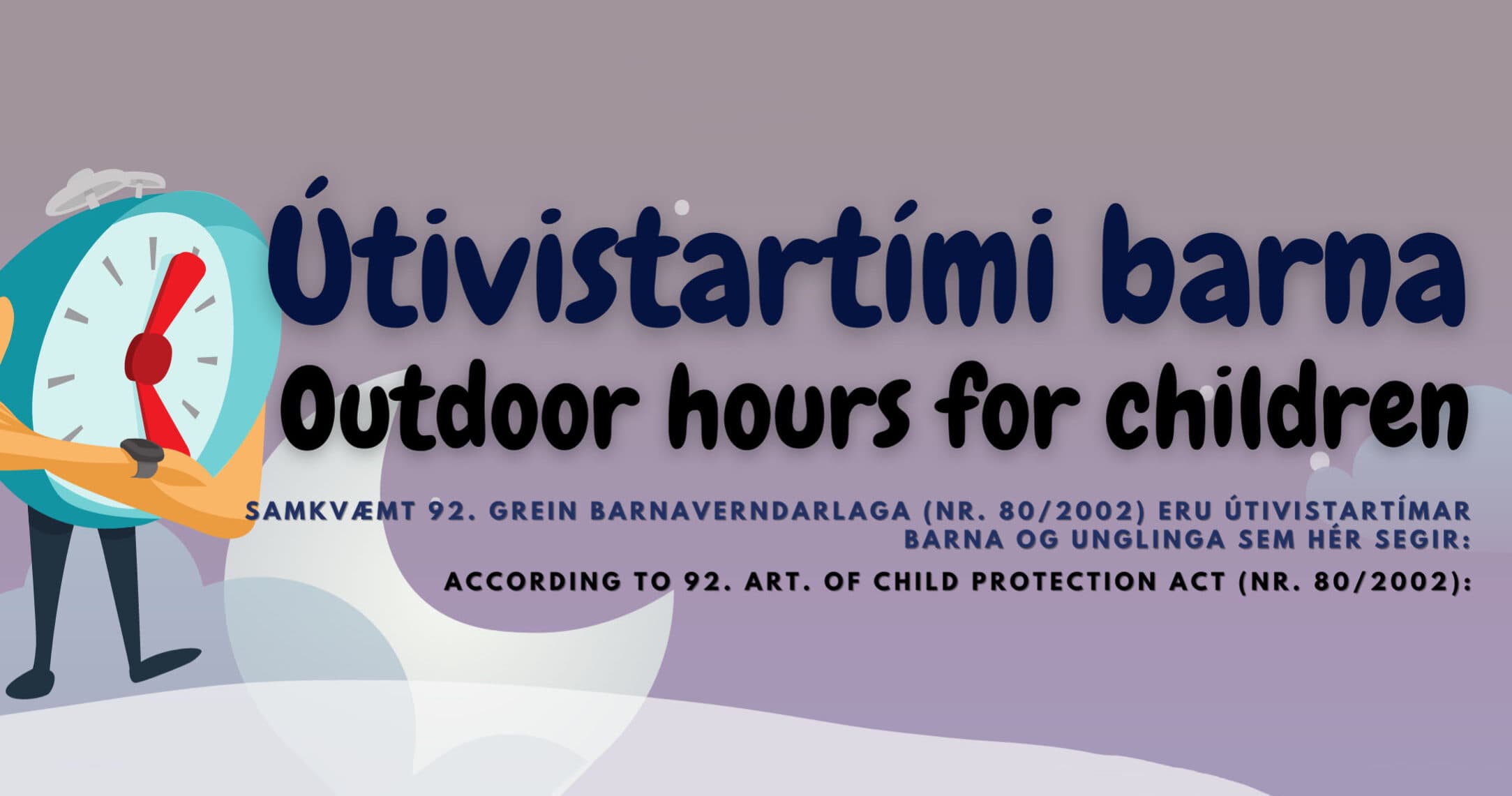
Outdoor hours for children
Here you find information about outdoors hours for children in six languages. The law in Iceland state how long children aged 0-16 may be outside in the evenings without adult supervision. These rules are intended to ensure that children will grow up in a safe and healthy environment with sufficient sleep.
Children 13 - 16 years out in public
Children aged 13 to 16, unaccompanied by adults, may not be outdoors after 22:00, unless on their way home from a recognised event organised by a school, sports organisation, or youth club.
During the period from 1 May to 1 September, children are permitted to stay outdoors an additional two hours, or until midnight at the latest. The age limits for this provision refer to the year of birth, not to the date of birth.
As for working, young adults are, in general, not allowed to do work that is beyond their physical or psychological capacity or involves risk to their health. They need to familiarize themselves with risk factors in the work environment that can threaten their health and safety, and therefore they need to be provided with appropriate support and training. Read more about Young People at Work.
Bullying
Bullying is repeated or continual harassment or violence, whether physical or mental, by one or more persons against another. Bullying can have serious consequences for the victim.
Bullying takes place between an individual and a group or between two individuals. Bullying can be verbal, social, material, mental and physical. It can take the form of name-calling, gossip, or untrue stories about an individual or encouraging people to ignore certain individuals. Bullying also includes repeatedly mocking somebody for their appearance, weight, culture, religion, skin colour, disability, etc. The victim of bullying may feel unwelcome and excluded from a group, to which they have no choice other than to belong, for instance, a school class or a family. Bullying can also have permanently damaging consequences for the perpetrator.
It is the duty of schools to react to bullying, and many primary schools have set up action plans and preventive measures.
Useful links
- Information brochure: Our children and ourselves
- Child Protection Act
- The Office of the Ombudsman for Children
- Amnesty International - Iceland
- The Icelandic Human Rights Institute
- Save the Children’s tipline
- Menntagátt
- Leisure Activities in the Capital Region
- Young People at Work - Administration of Occupational Safety and Health
- 112 - Emergency
Parents are obliged to protect their children from violence and other threats.