Informational brochures for refugees
The Multicultural Information Centre has published brochures with information for people who have just been granted the status of refugees in Iceland.
They have been manually translated to English, Arabic, Persian, Spanish, Kurdish, Icelandic and Russian and can be found in our published material section.
For other languages, you can use this page to translate the information to what ever language you want using the on-site translation feature. But note, it´s a machine translation, so it´s not perfect.
Informational brochures - Professionally translated into 6 languages
The Multicultural Information Centre has published informational brochures for refugees on society and systems in Iceland about registration into important systems, housing, work, children and young people, healthcare and health & safety.
These brochures have been professionally translated to English, Arabic, Persian, Spanish, Kurdish and Russian and can be found here in PDF.
Registration to important systems
ID number (kennitala; kt.)
- A social worker or your contact person at the Directorate of Immigration (Útlendingastofnun, ÚTL) can check when your ID number (kennitala) is ready and activated.
- When your ID is ready, the Social Services (félagsþjónustan) can help you apply for financial assistance.
- Book an appointment with a social worker and apply for the assistance (social benefits) that you have a right to.
- The directorate (ÚTL) will send you an SMS message to tell you when you can go to pick up your residence permit card (dvalarleyfiskort) at Dalvegur 18, 201 Kópavogur.
Bank account
- Once you have your residence permit card, you must open a bank account (bankareikningur).
- Spouses (husband and wife or other partnerships) must each open each a separate bank account.
- Your salary, financial assistance (grants of money: fjárhagsaðstoð) and payments from the authorities will always be paid into bank accounts.
- You can choose the bank where you want to have your account. Take your residence permit card (dvalarleyfiskort) and your passport or travel documents, if you have them.
- It is advisable to call beforehand and find out if you need to make an appointment.
- You must go to the social services (félagsþjónustan) and give the details of your bank account number so that it can be included in your application for financial assistance.
On-line banking (heimabanki og netbanki: home banking and electronic banking)
- You must apply for an online banking facility (heimabanki, netbanki) so that you can see what you have in your account and pay your bills (invoices; reikningar).
- You can ask the staff at the bank to help you download the online app (netbankaappið) in your smartphone.
- Memorize your PIN (the Personal Identity Number you use to make payments from your bank account). Do not carry it on you, written down in a way that someone else could understand and use, if they find it. Do not tell other people your PIN (not even to the police or the staff of the bank, or to people you do not know).
- N.B.: Some of the invoices to be paid on your netbanki are marked as optional (valgreiðslur). These usually come from charities asking for contributions. You are free to decide whether you pay them or not. You can delete them (eyða), if you choose not to pay them.
- Most optional payment invoices (valgreiðslur) come up in your netbanki, but they can also come in the post. Therefore, it is important to know what invoices are for before you decide to pay them.
Rafræn skilríki (electronic identification)
- This is a way of proving your identity (who you are) when you are using electronic communication (websites on the internet). Using electronic identification (rafræn skilríki) is just like showing an ID document. You can use it to sign forms online and when you do, it will have the same meaning as if you signed on paper with your hand.
- You will need to use rafræn skilríki to identify yourself when you open, and sometimes sign, web pages and online documents that many government institutions, municipalities (local authorities) and banks use.
- Everyone must have rafræn skilríki. Spouses (husbands and wives) or members of other family partnerships, must each have their own.
- You can apply for rafræn skilríki in any bank, or through Auðkenni.
- When you apply for rafræn skilríki you must have with you a mobile phone with an Icelandic number and a valid driving licence or passport. Travel documents issued by the Department of Immigration (ÚTL) are accepted as ID documents in substitution of a driving license or passport.
- Further information: https://www.skilriki.is/ and https://www.audkenni.is/.
Refugees’ travel documents
- If, as a refugee, you cannot show a passport from your home country, you must apply for travel documents. These will be accepted as ID documents in the same way as a driving licence or passport.
- You can apply for travel documents to the Directorate of Immigration (Útlendingastofnun, ÚTL). They cost 6.000 ISK.
- You can pick up an application form from the ÚTL office at Dalvegur 18, 201 Kópavogur, present it there and pay for the application. The Immigration Office (ÚTL) is open from Monday to Friday from 09.00 to 14.00. If you are living outside the metropolitan (capital) area, you can pick up a form from your local District Commissioner’s Office (sýslumaður) and hand it in there (https://island.is/s/syslumenn/hofudborgarsvaedid).
- Staff at ÚTL will not help you to fill in your application form.
- When your application has been accepted, you will get an SMS notifying you when you are scheduled to have an appointment for your photograph to be taken.
- After your photograph has been taken, it will take another 7-10 days before your travel documents are issued.
- Work is in progress at ÚTL on a simpler procedure for the issue of travel documents.
Passports for foreign nationals
- If you have been granted protection on humanitarian grounds, you can get a foreign national’s passport instead of temporary travel documents.
- The difference is that with travel documents, you can travel to all countries except your home country; with a foreign national’s passport you can travel to all countries including your home country.
- The application procedure is the same as for travel documents.
Sjúkratryggingar Íslands (SÍ: The Icelandic Health Insurance)
- If you have just been granted the status of a refugee, or protection on humanitarian grounds, the rule requiring 6 months’ residence in Iceland before qualifying for health insurance will not apply; in other words, you will be covered by the National Health Insurance immediately after receiving international protection.
- Refugees have the same rights with SÍ as everyone else in Iceland.
- SÍ pays part of the cost of medical treatment and of the prescription medications that meet certain requirements.
- ÚTL sends information to SÍ so that refugees are registered in the health insurance system.
Housing - Renting a flat
Looking for somewhere to live
- After you have been granted refugee status in Iceland, you may continue living in the accommodation (place) for people applying for international protection for only eight weeks more. Therefore, finding private accommodation should be a top priority for you
- You can find accommodation (housing, apartments) to rent on the following websites:
http://fasteignir.visir.is/#rent
https://www.mbl.is/fasteignir/leiga/
https://bland.is/solutorg/fasteignir/herbergi-ibudir-husnaedi-til-leigu/?categoryId=59&sub=1
https://leiguskjol.is/leiguvefur/ibudir/leit/
Facebook – “leiga” (rent)
Lease (rental agreement, rent contract, húsaleigusamningur)
- A lease gives you, as the tenant, certain rights.
- The lease is registered with the District Commissioner’s Office (Sýslumaður). You can find the District Commissioner’s Office in your area here: https://www.syslumenn.is/
- You must show a lease at the social services to be able to apply for a loan for the deposit to guarantee the payment of rent, rent benefits (money you get back from the tax you pay) and special assistance to cover your housing costs.
- You will have to pay a deposit to your landlord to guarantee that you will pay your rent and cover possible damage to the property. You can apply to social services for a loan to cover this, or alternatively through https://leiguvernd.is or https://leiguskjol.is.
- Remember: it is important to treat the apartment well, follow the rules, and pay your rent at the right time. If you do this, you will get a good reference from the landlord, which will help when you rent another apartment.
Notice period for terminating a lease
- The notice period for a lease for an indefinite period is:
- 3 months – for both landlord and tenant – for the rent of a room.
- 6 months for rent of an apartment (flat), but 3 months if you (the tenant) have not given proper information or do not meet the conditions stated in the lease.
- If the lease is for a definite period, then it will expire (come to an end) on the date agreed, and neither you nor the landlord must give notice before this. If you, as the tenant, have not given all necessary information, or if you do not meet the conditions stated in the lease, the landlord may terminate (end) a lease for a definite period with 3 months’ notice.
Housing benefits
- Housing benefits are a monthly payment intended to help people with low incomes pay their rent.
- Housing benefits depend on the amount of rent you pay, the number of people in your home and the combined income and liabilities of all those people.
- You must send in a registered lease.
- You must transfer your domicie (lögheimili; the place where you are registered as living) to your new address before you apply for housing benefits. You can go to the following link to do that: https://www.skra.is/umsoknir/rafraen-skil/flutningstilkynning/
- You apply for housing benefits here: https://island.is/en/housing-benefits
- For more information, see: https://island.is/en/housing-benefits/conditions
- If you are entitled to HMS housing benefits, you might also be entitled to Special Housing Aid directly from the municipality. Find further information on the following websites:
- Reykjavik: https://reykjavik.is/en/special-housing-aid
- Reykjanesbær: https://www.reykjanesbaer.is/is/thjonusta/velferd-og-studningur/husnaedismal/husnaedisbaetur
- Kópavogur: https://www.kopavogur.is/is/ibuar/felagslegur-studningur/husaleigubaetur
- Hafnarfjörður: https://hafnarfjordur.is/thjonusta/velferd/felagsleg-urraedi/husnaedisadstod/#
- Mosfellsbær: https://mos.is/stjornsysla/baejarstjorn-rad-og-nefndir/reglur-og-samthykktir/serstakur-husnaedisstudningur
Social assistance with housing
A social worker can help you apply for financial help with the cost of renting and furnishing a place to live in. Remember that all applications are considered in terms of your circumstances, and you must meet all the conditions set by the municipal authorities to qualify for assistance.
- Loans granted so that you can pay the deposit on rented housing are normally equal to 2-3 months’ rent.
- Furniture grant: This is to help you buy necessary furniture (beds; tables; chairs) and equipment (a fridge, stove, washing machine, toaster, kettle, etc.). The amounts are:
- Up to ISK 100,000 (maximum) for ordinary furniture.
- Up to ISK 100,000 (maximum) for necessary equipment (electrical appliances).
- ISK 50,000 additional grant for each child.
- Special housing assistance grants: Monthly payments on top of housing benefits. This special assistance varies from one municipality to another.
Deposits on rented flats
- It is common for the tenant to have to pay a deposit (surety) equal to 2 or 3 months’ rent as a guarantee at the beginning of the rent period. You can ask for assistance from the social services to cover the deposit.
- Sometimes it is possible that the municipalities guarantee the payment of a deposit for the tenant to meet their obligations according to a lease agreement (up to 600.000 ISK). The tenant needs to present the leasing contract to the Social Services and apply there.
- The deposit will be returned to the tenant´s bank account at the end of the renting period.
- When you move out, it is important to give back the apartment in good condition, with everything as it was when you moved in.
- Ordinary maintenance (small repairs) is your responsibility; if any problems arise (for example a leak in the roof) you must tell the landlord (owner) immediately.
- You, the tenant, will be responsible for any damage that you cause to the property and will have to pay the cost. If you want to fix anything to a wall, or the floor or ceiling, drill holes, or paint, you must first ask the landlord for permission.
- When you first move into the apartment, it is a good idea to take photographs of anything unusual that you notice and to send copies to the landlord by e-mail to show the condition of the apartment when it was handed over to you. You cannot then be made responsible for any damage that was already there before you moved in.
Common damage to rented premises (flats, apartments)
Remember these rules to avoid damaging the premises:
- Moisture (damp) is often a problem in Iceland. Hot water is cheap, so people tend to use it a lot: in the shower, in the bath, washing dishes and washing clothes. Be sure to reduce indoor humidity (water in the air) by opening windows and airing all rooms out for 10-15 minutes a few times every day and wipe up any water that forms on windowsills.
- Never pour water directly onto the floor when you are cleaning: use a cloth and squeeze extra water out of it before wiping the floor.
- It is the custom in Iceland not to wear shoes indoors. If you walk into the home in your shoes, moisture and dirt are brought in with them, which damages the flooring.
- Always use a chopping board (made of wood or plastic) for cutting and chopping food. Never cut direct onto tables and workbenches.
Common parts (sameignir – parts of the building you share with others)
- In most multi-owner dwellings (blocks of flats, apartment blocks) there is a residents’ association (húsfélag). The húsfélag holds meetings to discuss problems, agree on rules for the building and decide how much people must pay each month to a shared fund (hússjóður).
- Sometimes the húsfélag pays for a cleaning company to clean the parts of the building that everyone uses but nobody owns (the entrance lobby, the stairs, the laundry room, passageways, etc.); sometimes the owners or occupants share this work and take it in turns to do the cleaning.
- Bicycles, pushchairs, prams and sometimes snow-sleds may be kept in the hjólageymsla (‘bicycle storeroom’). You should not keep other things in these shared places; each flat usually has its own storeroom (geymsla) for keeping your things.
- You must find out the system for using the laundry (room for washing clothes), washing and drying machines and clothes-drying lines.
- Keep the rubbish bin room clean and tidy and make sure you sort items for recycling (endurvinnsla) and put them in the right bins (for paper and plastic, bottles, etc.); there are signs on the top showing what each bin is for. Do not put plastic and paper into ordinary rubbish. Batteries, hazardous substances (spilliefni: acids, oil, paint, etc.) and rubbish that should not go into the ordinary rubbish bins must be taken to the local collection containers or recycling companies (Endurvinnslan, Sorpa).
- There must be peace and quiet at night, between 10 p.m. (22.00) and 7 a.m. (07.00): do not have loud music or make noise that will disturb other people.
Work
Working and jobs in Iceland
The employment rate (the proportion of people who work) in Iceland is very high. In most families, both adults usually have to work so as to run their home. When both work outside the home, they must also help each other to do the housework and bring up their children.
Having a job is important, and not just because you earn money. It also keeps you active, involves you in society, helps you make friends and play your part in the community; it results in a richer experience of life.
Protection and work permit
If you are under protection in Iceland, you may live and work in the country. You do not have to apply for a special work permit, and you may work for any employer.
The Directorate of Labour (Vinnumálastofnun; VMST)
There is a special team of staff at the directorate to advise and help refugees with:
- Looking for work
- Advice on opportunities for study (learning) and work
- Learning Icelandic and learning about Icelandic society
- Other ways of staying active
- Work with support
VMST is open Monday-Thursday from 09-15, Friday from 09-12. You can phone and book an appointment with a counsellor (advisor), or you can ask your social worker to book on behalf of you. VMST has branches all over Iceland. See here to find the one nearest you:
https://island.is/en/o/directorate-of-labour/service-offices
Job center at The Directorate of Labour (Vinnumálastofnun; VMST)
Job center (Atvinnutorg) is a service center within the Directorate of Labour:
- Opening hours: From Mon- Thu 13 to 15pm.
- Access to consultants.
- Access to computers.
- No need to book an appointment.
Employment agencies:
There is also a list of employment agencies on the VMST website: https://www.vinnumalastofnun.is/storf–i–bodi/adrar–vinnumidlanir
You can also find job vacancies advertised here:
Vísir — www.visir.is/atvinna
https://www.stjornarradid.is/efst-a-baugi/laus-storf-a-starfatorgi/
Hagvangur — www.hagvangur.is
HH Ráðgjöf — www.hhr.is
Ráðum — www.radum.is
Intellecta — www.intellecta.is
Evaluation and recognition of foreign qualifications
ENIC/NARIC Iceland provides help with the recognition of qualifications (examinations, degrees, diplomas) from outside Iceland, but it does not issue operating licences. http://www.enicnaric.is
- IDAN Education Centre (IÐAN fræðslusetur) evaluates foreign vocational qualifications (except for electrical trades): https://idan.is
- Rafmennt handles evaluation and recognition of electrical trade qualifications: https://www.rafmennt.is
- The Directorate of Public Health (Embætti landlæknis), the Directorate of Education (Menntamálatofnun) and the Ministry of Industries and Innovation (Atvinnuvega- og nýsköpunarráðuneytið) grant operating licences for the professions and trades under their authority.
A counsellor at VMST can explain to you where and how to have your qualifications or operating licences evaluated and recognised in Iceland.
Taxes
Iceland’s welfare system is financed by the taxes that we all pay. The state uses the money paid in tax to meet the costs of public services, the school system, the healthcare system, building and maintaining roads, making benefit payments, etc.
Income tax (tekjuskattur) is deducted from all wages and goes to the state; municipal tax (útsvar) is a tax on wages that is paid to the local authority (municipality) where you live.
Tax and personal tax credit
You have to pay tax on all your earnings and any other financial assistance that you receive.
- Everyone is given a personal tax credit (persónuafsláttur). This was ISK 68.691 per month in 2025. This means that if you tax is calculated as ISK 100,000 per month, you will only pay ISK31.309. Couples can share their personal tax credits.
- You are responsible for how your personal tax credit is used.
- Personal tax credits cannot be carried over from one year to the next.
- Your personal tax credit takes effect from the date on which your domicile (legal address; lögheimili) is registered in the National Registry. If, for example, you earn money starting in January, but your domicile is registered in March, you must make sure that your employer does not think you have a personal tax credit in January and February; if this happens, you will end up owing money to the tax authorities. You must be particularly careful about how your personal tax credit is used if you work in two or more jobs, if you receive payment from the Parental Leave Fund (fæðingarorlofssjóður) or from the Directorate of Labour or financial assistance from your local authority.
If, by mistake, more than 100% personal tax credit is applied to you (for example, if you work for more than one employer, or receive benefit payments from more than one institution), you will have to pay money back to the tax authorities. You must tell your employers or other sources of payment how your personal tax credit is being used and make sure the right proportion is applied.
Tax returns (skattaskýrslur, skattframtal)
- Your tax return (skattframtal) is a document showing all your income (wages, pay) and also what you own (your assets) and what money you owed (liabilities; skuldir) during the previous year. The tax authorities must have the right information so that they can calculate what taxes you should pay or what benefits you should receive.
- You must send in your tax return on-line at http://skattur.is at the beginning of March each year.
- You log in to the tax website with a code from RSK (the tax authority) or using electronic ID.
- Icelandic Revenue and Customs (RSK, the tax authority) prepares your on-line tax return, but you must check it over before it is approved.
- You can go to the tax office in person in Reykjavík and Akureyri for help with your tax return, or get help by phone at 442-1000
- RSK does not provide interpreters. (If you do not speak Icelandic or English you will need to have your own interpreter).
- Instructions in English about how to send in your tax return:
https://www.rsk.is/media/baeklingar/rsk_0812_2020.en.pdf
Trade unions
- The main role of trade unions is to make agreements with employers regarding the wages and other terms (vacations, working hours, sick leave) that union members will receive and to defend their interests on the labour market.
- Everyone who pays dues (money each month) to a trade union earns rights with the union and can accumulate more extensive rights as time goes on, even over a short time at work.
- You can find your union on your monthly salary payslip, or you can ask your employer, this is your right.
How your trade union can help you
- With information about your rights and duties on the labour market.
- By helping you calculate your wages.
- Help you if you have doubts about your rights that may have been violated.
- Various types of grants (financial help) and other services.
- Access to vocational rehabilitation if you fall ill or have an accident at work.
- Some trade unions pay part of the cost if you have to travel between different parts of the country for an operation or medical examination prescribed by a doctor, but only if you have first applied for assistance from the Social Insurance Administration (Tryggingarstofnun) and your application has been turned down.
Financial help (grants) from trade unions
- Grants for you to attend workshops and study aligned with your job.
- Grants for help you improve and look after your health, e.g. to pay for cancer testing, massage, physiotherapy, fitness classes, glasses or contact lenses, hearing aids, consultations with psychologists/psychiatrists, etc.
- Per diem allowances (financial support for each day if you fall ill; sjúkradagpeningar).
- Grants to help meet expenses because your partner or child is ill.
- Vacation grants or payment of the cost of renting summer holiday cottages (orlofshús) or apartments available for short rentals (orlofsíbúðir).
Being paid under the table (svört vinna)
When workers are paid for their work in cash and there is no invoice (reikningur), no receipt (kvittun), and no ayslip (launaseðill), this is called ‘payment under the table’ (svört vinna, að vinna svart – ‘working black’). It is against the law, and it weakens the healthcare, social welfare and educational systems. If you accept payment ‘under the table’ you will also not earn rights in the same way as other workers.
- You will have no pay when you are on vacation (annual holiday)
- You will have no pay when you are ill or cannot work after an accident
- You will not be insured if you have an accident while you are at work
- You will not be entitled to unemployment benefit (pay if you lose your jobs) or parental leave (time off work after the birth of a child)
Tax fraud (tax avoidance, cheating on tax)
- If, on purpose, you avoid paying tax, you will have to pay a fine of at least twice the amount you should have paid. The fine can be as much as ten times the amount.
- For large-scale tax fraud you may go to prison for as long as six years.
Children and young people
Children and their rights
People under the age of 18 are classed as children. They are legal minors (they are not able to take on responsibilities according to law) and their parents are their guardians. Parents have a duty to look after their children, care for them and treat them with respect. When parents make important decisions for their children, they should listen to their views and respect them, in accordance with the children’s age and maturity. The older the child is, the more their opinions should count.
- Children have the right to spend time with both their parents, even if the parents do not live together.
- Parents have a duty to protect their children against disrespectful treatment, mental cruelty and physical violence. Parents are not allowed to act violently towards their children.
- In Iceland, all corporal punishment of children is prohibited by law — including by parents and caregivers. If you come from a country where corporal punishment is considered acceptable, please note that it is not allowed in Iceland and may lead to investigation by child protection authorities. It is important to use parenting methods that are safe, respectful, and in accordance with Icelandic law. If you need more information or support, please contact the social services in your municipality.
- Parents have a duty to provide their children with housing, clothes, food, school equipment and other necessary items.
- According to Icelandic law, female genital mutilation is strictly prohibited, regardless of whether it is carried out in Iceland or abroad. The sentence it carries can be up to 16 years in prison. Both the attempted crime, as well as the participation in such an act, is also punishable. The Law is applicable to all Icelandic citizens, as well as those residing in Iceland, at the time of the crime.
- Children may not be married in Iceland. Any marriage certificate that shows that one or both persons in a marriage were under the age of 18 at the time of the marriage is not accepted as valid in Iceland.
- Here you can find information about different types of violence, along with guidance for parents whose children experience or show violent behaviour.
Advice for parents to prevent youth violence
Violence against children | Lögreglan
For more information about children’s rights in Iceland, see:
Preschool
- Preschool (kindergarten) is the first stage of the school system in Iceland and is for children aged 6 and younger. Preschools follow a special programme (National Curriculum Guide).
- Preschool is not compulsory in Iceland, but about 96% of children aged 3-5 attend preschool.
- Preschool staff are professionals who are trained to teach, educate, and care for children. A lot of effort is put into making them feel good and developing their talents to the maximum, according to each one needs.
- Children in preschool learn by playing and making things. These activities lay the basis for their education in the next level of school. Children who have been through preschool are better prepared for learning in junior (compulsory) school. This is particularly true in the case of children who do not grow up speaking Icelandic at home: they learn it in preschool.
- Preschool activities give children whose mother tongue (first language) is not Icelandic a good grounding in Icelandic. At the same time, the parents are encouraged to support the child’s first-language skills and learning in various ways.
- Preschools try, as far as they can, to ensure that important information is presented in other languages for the children and their parents.
- Parents must register their children for preschool places. You do this on the on-line (computer) systems of the municipalities (local authorities; for example, Reykjavík, Kópavogur). For this, you must have an electronic ID.
- The municipalities subsidise (pay a large part of the cost of) preschools, but preschools are not completely free of charge. The cost for each month is slightly different from one place to another. Parents who are single, or are studying or who have more than one child attending preschool, pay a smaller charge.
- Children in preschool play outside on most days, so it is important that they have proper clothing according to the weather (cold wind, snow, rain or sun). http://morsmal.no/no/foreldre-norsk/2382-kle-barna-riktig-i-vinterkulda
- Parents stay with their children at preschool on the first few days to help them to get used to it. There, the parents are given all the most important information.
- For more about preschools in several languages, see the Reykjavík City website: https://mml.reykjavik.is/2019/08/30/baeklingar-fyrir-foreldra-leikskolabarna-brouchures-for-parents/
Junior school (grunnskóli; compulsory school, up to age 16)
- By law, all children in Iceland aged 6-16 must go to school.
- All schools work according to the National Curriculum Guide for Compulsory Schools, which is set by the Althingi (parliament). All children have an equal right to attend school, and the staff try to make them feel well at school and make progress with their school work.
- Junior school in Iceland is free of charge.
- School meals are free of charge.
- All junior schools follow a special programme to help children adapt (fit in) at school if they do not speak Icelandic at home.
- Children whose home language is not Icelandic have the right to be taught Icelandic as their second language. Their parents are also encouraged to help them learn their own home languages in various ways.
- The junior schools try, as far as they can, to ensure that information that is important for contact between teachers and parents is translated.
- Parents must register their children for junior school and after-school activities. You do this on the on-line (computer) systems of the municipalities (local authorities; for example, Reykjavík, Kópavogur). For this, you must have an electronic ID.
- Most children go to the local junior school in their area. They are grouped in classes by age, not by ability.
- Parents have a duty to tell the school if a child is ill or has to miss school for other reasons. You must ask the head teachers, in writing, for permission for your child not to attend school for any reason.
- https://mml.reykjavik.is/bruarsmidi/
Junior school, after-school facilities and social centres
- Sports and swimming are compulsory for all children in Icelandic junior schools. Normally, boys and girls are together in these lessons.
- Pupils (children) in Icelandic junior schools go outside twice a day for short breaks so it is important for them to have proper clothes for the weather.
- It is important for children to bring healthy snack food to school with them. Sweets are not permitted in junior school. They should bring water to drink (not fruit juice). In most schools, children can have hot meals at lunch time. Parents must pay a small charge for these meals.
- In many municipal areas, pupils can have help with their homework, either in school or in the local library.
- Most schools have after-school facilities (frístundaheimili) offering organised leisure activities for children aged 6-9 after school hours; you must pay a small charge for this. The children have a chance to talk to each other, make friends and learn Icelandic by playing together with others.
- In most areas, either in the schools or close to them, there are social centres (félagsmiðstöðvar) offering social activities for children aged 10-16. These are designed to involve them in positive social interaction. Some centres are open in the late afternoon and evening; others in school breaktime or the lunch break in school.
Schools in Iceland – traditions and customs
Junior schools have school councils, pupils’ councils and parents’ associations to look after pupils’ interests.
- Some special events take place during the year: parties and trips that are organised by the school, the pupils’ council, the class representatives or the parents’ association. These events are advertised specially.
- It is important that you and the school communicate and work together. You will meet the teachers twice each year to talk about your children and how they are doing in school. You should feel free to contact the school more often if you want to.
- It is important that you (the parents) come to class parties with your children to give them attention and support, see your child in the school environment, see what goes on in the school and meet your children’s classmates and their parents.
- It is common that the parents of children who play together also have a lot of contact with each other.
- Birthday parties are important social events for children in Iceland. Children who have birthdays close together often share a party so as to be able to invite more guests. Sometimes they invite only girls, or only boys, or the whole class, and it is important not to leave anyone out. Parents often make an agreement about how much presents should cost.
- Children in junior schools do not normally wear school uniforms.
Sports, arts and leisure activities
It is considered important that children take part in leisure activities (outside school hours): sports, arts and games. These activities play a valuable part in preventive measures. You are urged to support and help your children to take an active part with other children in these organised activities. It is important to find out about the activities on offer in your area. If you find the right activity for your children, this will help them to make friends and give them a chance to get used to speaking Icelandic. Most municipalities give grants (money payments) to make it possible for children to follow leisure activities.
- The main aim of the grants is to make it possible for all children and young people (aged 6-18) to take part in positive after-school activities no matter what sort of homes they come from and whether their parents are rich or poor.
- The grants are not the same in all municipalities (towns) but are ISK 35,000 – 50,000 per year per child.
- Grants are paid electronically (online), directly to the sports or leisure club involved.
- In most municipalities, you must register in the local online system (e.g. Rafræn Reykjavík, Mitt Reykjanes or Mínar síður in Hafnarfjörður) to be able to register your children for school, preschool, leisure activities, etc. For this, you will need an electronic ID (rafræn skilriki).
Upper secondary school (framhaldsskóli)
- Upper secondary school prepares pupils for going out to work or going on with further studies. Framhaldsskólar á landinu
- Upper secondary school is not compulsory but those who have completed junior (compulsory) school and passed the junior school examination or equivalent, or have turned 16, can begin upper secondary school. Innritun í framhaldsskóla
- For more information, see: https://www.island.is/framhaldsskolar
Rules on children out of doors
The law in Iceland says how long children aged 0-16 may be outside in the evenings without adult supervision. These rules are intended to ensure that children will grow up in a safe and healthy environment with sufficient sleep.
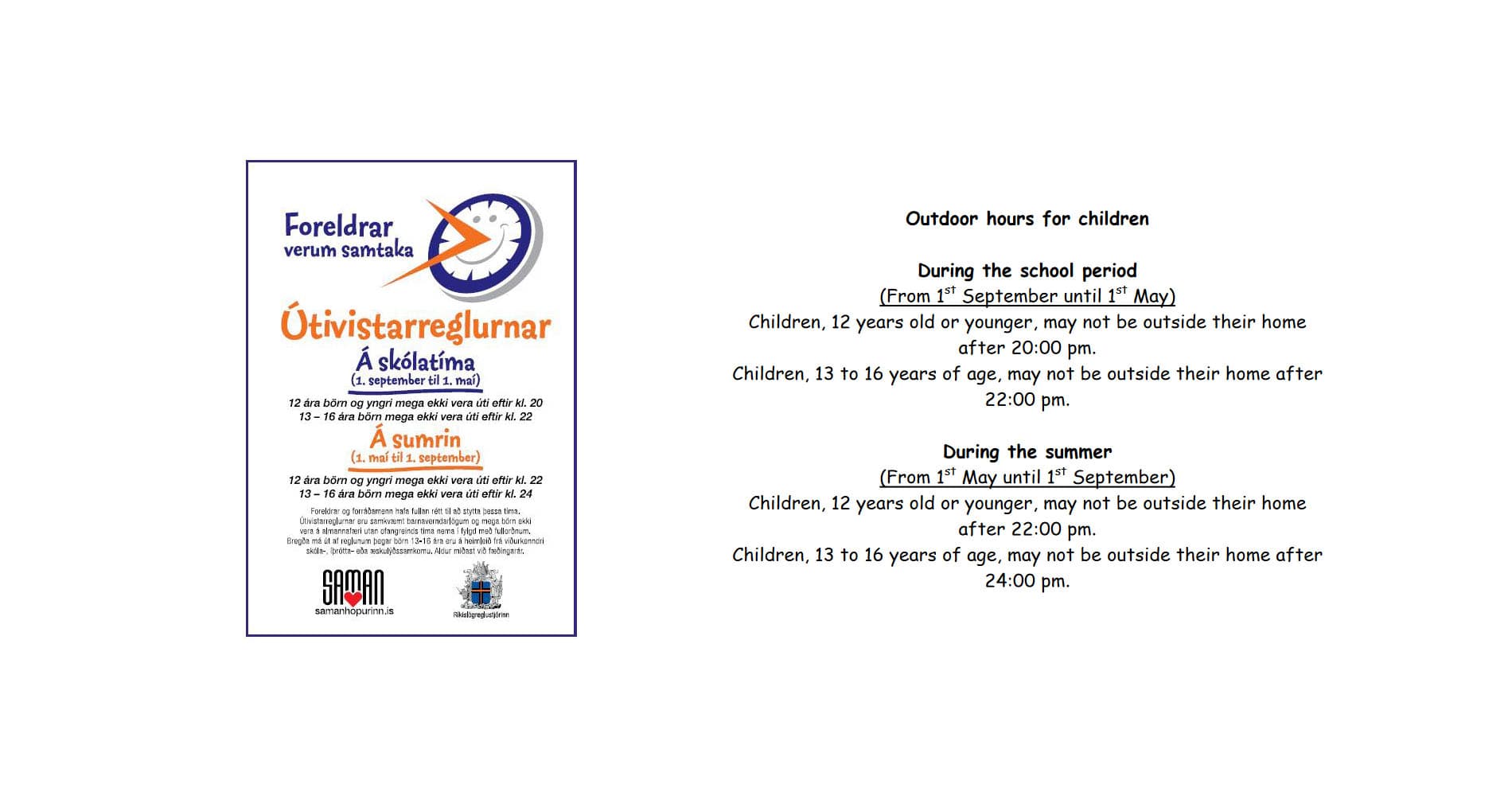
Parents, let´s work together! Outdoors hours for children in Iceland
Outdoor hours for children During the school period (From 1st September until 1st May)
Children, 12 years old or younger, may not be outside their home after 20:00 pm.
Children, 13 to 16 years of age, may not be outside their home after 22:00 pm. During the summer (From 1st May until 1st September)
Children, 12 years old or younger, may not be outside their home after 22:00 pm.
Children, 13 to 16 years of age, may not be outside their home after 24:00 pm.
Parents and caregivers have absolute rights to reduce these outdoor hours. These rules are in accordance with the Icelandic Child Protection laws and forbid children to be in public places after the stated hours without adult supervision. These rules can be exempted if children 13 to 16 years of age are on their way home from an official school, sports, or a youth centre’s activity. The child’s birth year rather than its birthday applies.
The Prosperity Act (Farsæld barna)
In Iceland, a new law has been introduced to support children’s well-being. It is called the Act on Integrated Services in the Interest of Children’s Prosperity — also known as the Prosperity Act.
This law ensures that children and families don’t get lost between different systems or have to navigate services on their own. Every child has the right to receive the help they need, when they need it.
Finding the right support can sometimes be difficult, and this law aims to make it easier by ensuring that the right services are provided, at the right time, by the right professionals. Children and parents can request integrated services at all school levels, through social services, or at health clinics.
You can learn more about the Prosperity act here: https://www.farsaeldbarna.is/en/home.
Support for Children from Municipal Social Services
- Educational counsellors, psychologists, and speech therapists at the Municipal School Service offer advice and support to parents of children in preschool and compulsory school.
- Parents and children can receive guidance and assistance in dealing with difficult situations, such as financial hardship, parenting challenges, or social isolation at their local Social Services
- You can apply to the Social Services for financial assistance to help cover costs such as preschool fees, after-school programs, summer camps, or sports and leisure activities.
Please note that the amount of support available may vary depending on your municipality. - NB Each application is reviewed individually, and every municipality has its own rules for granting financial support.
Child Protection Services in Iceland
- Municipalities in Iceland are responsible for child protection and must follow national child protection laws.
- Child protection services are available in all municipalities. Their role is to support children and parents facing serious challenges and to ensure the child’s safety and well-being.
- Child protection workers are specially trained professionals, often with backgrounds in social work, psychology, or education.
- If needed, they can receive additional support and guidance from the National Agency for Children and Families (Barna- og fjölskyldustofa), especially in complex cases.
In some situations, local district councils have the authority to make formal decisions in child protection matters.
Duty to Report
Everyone has a legal obligation to contact child protection services if they suspect that a child:
- is living in unacceptable conditions,
- is being subjected to violence or degrading treatment, or
- is at serious risk of harm to their health or development.
This duty also applies if there is reason to believe that the health, life, or development of an unborn child may be seriously at risk due to the lifestyle, behaviour, or circumstances of the expecting parents — or for any other reason that may concern child protection services.
Child protection services in Iceland are primarily focused on support and cooperation with families. This means, for example, that a child is not removed from their parents unless all other efforts to strengthen the family and improve parenting have proven unsuccessful.
According to the UN Convention on the Rights of the Child, a child should not be separated from their parents unless it is necessary for the child’s well-being and in their best interests.
Child benefit
- Child benefit is an allowance (money payment) from the tax authorities to parents (or single/divorced parents) for the children registered as living with them.
- Child benefit is income related. This means that if you have low wages, you will receive higher benefit payments; if you earn more money, the benefit amount will be smaller.
- Child benefit is paid out 4 times per year, please check the link
Child benefits | Skatturinn – skattar og gjöld
- After a child is born or moves to their legal home (lögheimili) in Iceland, a certain time may pass before their parents receive child benefit. You can check with the social services office in your home country.
- Refugees can apply for extra payments from Social Services to cover make up the full amount. You must remember that all applications are considered separately, and each municipality has its own rules that must be followed when benefit payments are made.
The Social Insurance Administration (TR) – Financial Support for Children
Child support (meðlag) is a monthly payment made by one parent to the other when they do not live together (e.g. after separation or divorce). The child is registered as living with one parent, and the other parent pays. These payments legally belong to the child and must be used for their care.
You can request that the Social Insurance Administration (Tryggingastofnun ríkisins, TR) collect and transfer the payments to you. When you apply for child support you must submit the child’s birth certificate.
Child pension (barnalífeyrir) is a monthly payment from TR if one of the child’s parents has died or is receiving an old-age pension, disability benefit, or rehabilitation pension. A certificate or report from the UN Refugee Agency (UNHCR) or the Immigration Agency must be submitted to confirm the parent’s situation.
Mother’s or father’s allowance is a monthly payment from TR to single parents with two or more children legally domiciled with them.
Applications for child-related benefits now available on Island.is
You can now apply for child-related benefits directly through Island.is for various child-related benefits, such as:
https://island.is/en/application-for-child-pension
https://island.is/en/benefit-after-the-death-of-a-partner
https://island.is/en/parents-contribution-for-education-or-vocational-training
https://island.is/en/child-support/request-for-a-ruling-on-child-support
https://island.is/en/care-allowance
https://island.is/en/parental-allowance-with-children-with-chronic-or-severe-illness
https://island.is/heimilisuppbot
Useful information
Umboðsmaður barna (The Children’s Ombudsman) works to ensure that children’s rights and interests are respected. Anyone can apply to the Children’s Ombudsman, and questions from children themselves always receive priority.
Tel.: 522-8999
Children’s phone line – free of charge: 800-5999
E-mail: ub@barn.is
Ráðgjafa og greiningastöð (The Consulting and Analysis Center) The role of the Counseling and Diagnostic Center is to ensure that children with severe developmental disabilities that may lead to disability later in life receive diagnosis, counseling, and other resources that improve their quality of life.
Tel: 510-8400
Email: rgr@rgr.is
Landssamtökin Þroskahjálp Throskahjalp focuses on being proactive in consultation, advocacy, and monitoring of the rights of persons with disabilities
Tel: 588-9390
Email: throskahjalp@throskahjalp.is
Barna og fjölskyldustofa (The National Agency for Children and Families) The agency handles child protection matters throughout the country. Its role is to provide and support services based on the best knowledge and practices at any given time. Barnahus children´s center is part of the agency and their role is to handles cases of children suspected of being sexually assaulted or abused. The Child Protective Services are responsible for handling such cases, and can also seek and request services from Barnahús on suspicion of other forms of violence against children. The Barnahús Children’s Center also provides education on sexual abuse, among other things, for parties working with children.
Tel: 530-2600
Email: bofs@bofs.is
Við og börnin okkar – Our children and us – Information for families in Iceland (in Icelandic and English).
Healthcare
Sjúkratryggingar Íslands (SÍ; Icelandic Health Insurance)
- As a refugee, you have the same right to healthcare services and insurance from SÍ as local citizens in Iceland.
- If you have just been granted international protection, or a residence permit in Iceland on humanitarian grounds, you do not have to meet the condition of living here for 6 months before qualifying for health insurance. (In other words, you are covered by health insurance immediately.)
- SÍ pays part of the cost of medical treatment and of the prescription medications that meet certain requirements.
- UTL sends information to SÍ so that you are registered in the health insurance system.
- If you live outside the metropolitan area, you can apply for grants (money) to cover part of the cost of travelling or accommodation (a place to stay) for two trips each year for medical treatment, or more if you must make repeated trips. You must apply in advance (before the trip) for these grants, except in emergencies. For further information, see:
https://island.is/greidsluthatttaka-ferdakostnadur-innanlands
https://island.is/gistinattathjonusta-sjukrahotel
Réttindagátt Sjúkratrygginga Íslands (SÍ’s ‘entitlements window’)
Réttindagátt is an online information portal, a sort of ‘my pages’ showing you the insurance you are entitled to (have a right to). There you can register with a doctor and dentist and send all the documents you need to send in a safe and secure way. You can find the following:
- Information about the co-payment system of SÍ, which ensures that individuals do not pay more than a certain maximum amount each month for health services. You can review your payment status under Health on Réttindagátt ‘my pages’.
- Whether you are entitled to have SÍ pay more of the cost for medical treatment, medicines (drugs) and other healthcare services.
- Further information on Réttindagátt SÍ: https://rg.sjukra.is/Account/Login.aspx
The health services
Iceland’s health services are divided into several parts and levels.
- Local health centres (heilsugæslustöðvar, heilsugæslan). These provide general medical services (doctor’s services), nursing (including home nursing) and other health care. They deal with minor accidents and sudden illnesses, maternity care and infant and children care (vaccinations). They are the most important part of the healthcare services apart from the hospitals.
- Hospitals (spítalar, sjúkrahús)provide services for people who need to undergo more specialised treatment and be cared for by nurses and doctors, either occupying beds as in-patients or attending out-patient departments. Hospitals also have emergency departments treating people with injuries or emergency cases, and children’s wards.
- Specialists’ services (sérfræðingsþjónusta). These are mostly provided in private practices, either by individual specialists or teams working together.
Under the Patients’ Rights Act, if you do not understand Icelandic, you are entitled to have an interpreter (someone who can speak your language) to explain to you information about your health and medical treatment that you are to have, etc. You must ask for an interpreter when you book your appointment with a doctor at a health centre or hospital.
Heilsugæsla (local health centres)
- You can register with any health centre. Either go to the health centre (heilsugæslustöð) in your area, with your ID document or register online at https://island.is/skraning-og-breyting-a-heilsugaeslu
- The health centre (heilsugæslan) is the first place to go to for medical services. You can phone for advice from a nurse; to talk to a doctor, you must first make an appointment (arrange a time for a meeting). If you need an interpreter (someone who speaks your language) you must say this when you make the appointment.
- If your children need specialist treatment, it is important to start by going to the health centre (heilsugæsla) and getting a referral (a request) first. This will cut the cost of seeing the specialist.
- You can call 1700 a telephone consultation. There you can talk to a nurse if you are not sure whom to talk to or to get all kind of information about health issues. They can also book an appointment for you at the health centre if necessary. Call 1700 all day and online chat is open from 8:00 to 22:00 every day of the week.
Psychologists and physiotherapists
Psychologists and physiotherapists usually have their private practices.
- If a doctor writes a referral (request; tilvísun) for you to have treatment by a physiotherapist, SÍ will pay 90% of the total cost.
- SÍ does not share the cost of going to a private psychologist. However, you can apply to your trade union (stéttarfélag) or the local social services (félagsþjónusta) for financial assistance. The health centers (heilsugæslan) offer some service of psychologists. You need to get a referral (request; tilvísun) from a doctor at the center.
Heilsuvera
- Heilsuvera https://www.heilsuvera.is/ is a website with information about health issues.
- In the ‘My pages’ (mínar síður) part of Heilsuvera you can contact staff of the healthcare services and find information about your own medical records, prescriptions, etc.
- You can use Heilsuvera to book appointments with the doctor, find out the results of tests, ask to have prescriptions (for medicines) renewed, etc.
- You must have registered for electronic identification (rafræn skilríki) to open mínar síður in
Healthcare institutions outside the metropolitan (capital) area
Healthcare in smaller places outside the metropolitan area is provided by regional healthcare institutions. These are
Vesturland (Westen Iceland)
Vestfirðir (West Fjords)
Norðurland (Northern Iceland)
Austurland (Eastern Iceland)
Suðurland (Southern Iceland)
Suðurnes
Pharmacies (chemists’, drugstores; apótek) outside the metropolitan area:
https://info.lifdununa.is/apotek-a-landsbyggdinni/
Metropolitan health service (Heilsugæsla á höfuðborgarsvæðinu)
- The metropolitan health service operates 15 health centres in Reykjavík, Seltjarnarnes, Mosfellsumdæmi, Kópavogur, Garðabær and Hafnarfjörður.
- For a survey of these health centres and a map kort showing where they are, see: https://www.heilsugaeslan.is/heilsugaeslustodvar/
Specialist services (Sérfræðiþjónusta)
- Specialists work both in the healthcare institutions and in private practice. In some cases, you need a referral (request; tilvísun) from your ordinary doctor to go to them; in others (for example, gynaecologists – specialists treating women) you can simply phone them and arrange an appointment.
- It costs more to go to a specialist than to an ordinary doctor at a health centre (heilsugæsla), so it is best to start at the health centre.
Dental treatment
- SÍ shares the cost of dental treatment for children. You must pay an annual fee of ISK 3,500 to the dentist for each child, but apart from that, your children’s dental treatment is free.
- You should take your children to the dentist for a check-up every year to prevent tooth decay. Do not wait until the child complains of toothache.
- SÍ shares the cost of dental treatment for senior citizens (over age 67), people with disability assessments and recipients of rehabilitation pensions from the Social Insurance Administration (TR). It pays 75% of the cost of dental treatment.
- SÍ does not pay anything towards the cost of dental treatment for adults (aged 18-66). You can apply to your trade union (stéttarfélag) for a grant to help with meeting these costs.
- As a refugee, if you do not qualify for a grant from your trade union (stéttarfélag), you can apply to the social services (félagsþjónustan) for a grant to pay part of your dental treatment costs.
Medical services outside ordinary office hours
- If you urgently need the services of a doctor or nurse outside the opening hours of the health centres, you should phone Læknavaktin (the after-hours medical service) 1700.
- Doctors at the local health clinics in the healthcare institutions outside the metropolitan area will answer calls in the evenings or at weekends, but if you can, then it is better to see them during the day, or use the phone service, tel. 1700 for advice, because the facilities during daytime hours are better.
- Læknavaktin for the metropolitan area is on the second floor of the shopping centre Austurver at Háaleitisbraut 68, 108 Reykjavík, tel. 1700, http://laeknavaktin.is/ It is open 17:00-22:00 on weekdays and 9:00 – 22:00 at weekends.
- Paediatricians (children’s doctors) run an evening and weekend service in https://barnalaeknardomus.is/ You can book appointments from 8:00 on weekdays and from 10:30 at weekends. Domus Medica is at Urðarhvarf 8, 203 Kópavogur, tel. 563-1010.
- For emergencies (accidents and sudden serious illness) phone 112.
Bráðamóttaka (Emergencies): What to do, where to go
- In emergencies, when there is a serious threat to health, life or property, phone the Emergency Line, 112. For more about the Emergency Line, see: https://www.112.is/
- Outside the metropolitan area there are Accident and Emergency (A&E departments, bráðamóttökur) in the regional hospitals in each part of the country. It is important to know where these are and where to go in an emergency.
- It costs much more to use the emergency services than to go to the doctor at a health centre during the day. Also, remember that you must pay for ambulance services. For this reason, it is recommended to use the A&E services in real emergencies only.
Bráðamóttaka (Accident & Emergency, A&E) at Landspítali
- Bráðamóttakan í Fossvogi The A&E reception at Landspítali in Fossvogur is open 24 hours a day, 7 days a week, all year round. You can go there for treatment for sudden serious illnesses or accident injuries that cannot wait for the procedure in the health centres or the after-hours service of Læknavaktin. Tel.: 543-2000.
- Bráðamóttaka barna For children, the emergency reception of the Children’s Hospital (Barnaspítala Hringsins) on Hringbraut is open 24 hours a day. This is for children and young people up to the age of 18. Tel.: 543-1000. NB in cases of an injury, children should go to the A&E department at Landspítali in Fossvogur.
- Bráðamóttaka geðsviðs The emergency reception of Landspítali’s Psychiatric Ward (for mental disorders) is on the ground floor of the Psychiatric Department on Hringbraut. Tel.: 543-4050. You can go there without making an appointment for urgent treatment for psychiatric problems.
Open: 12:00–19:00 Mon.-Fri. and 13:00-17:00 at weekends and public holidays. In emergencies outside these hours, you can go to the A&E reception (bráðamóttaka) in Fossvogur.
- For information about other emergency reception units of Landspítali, see here hér.
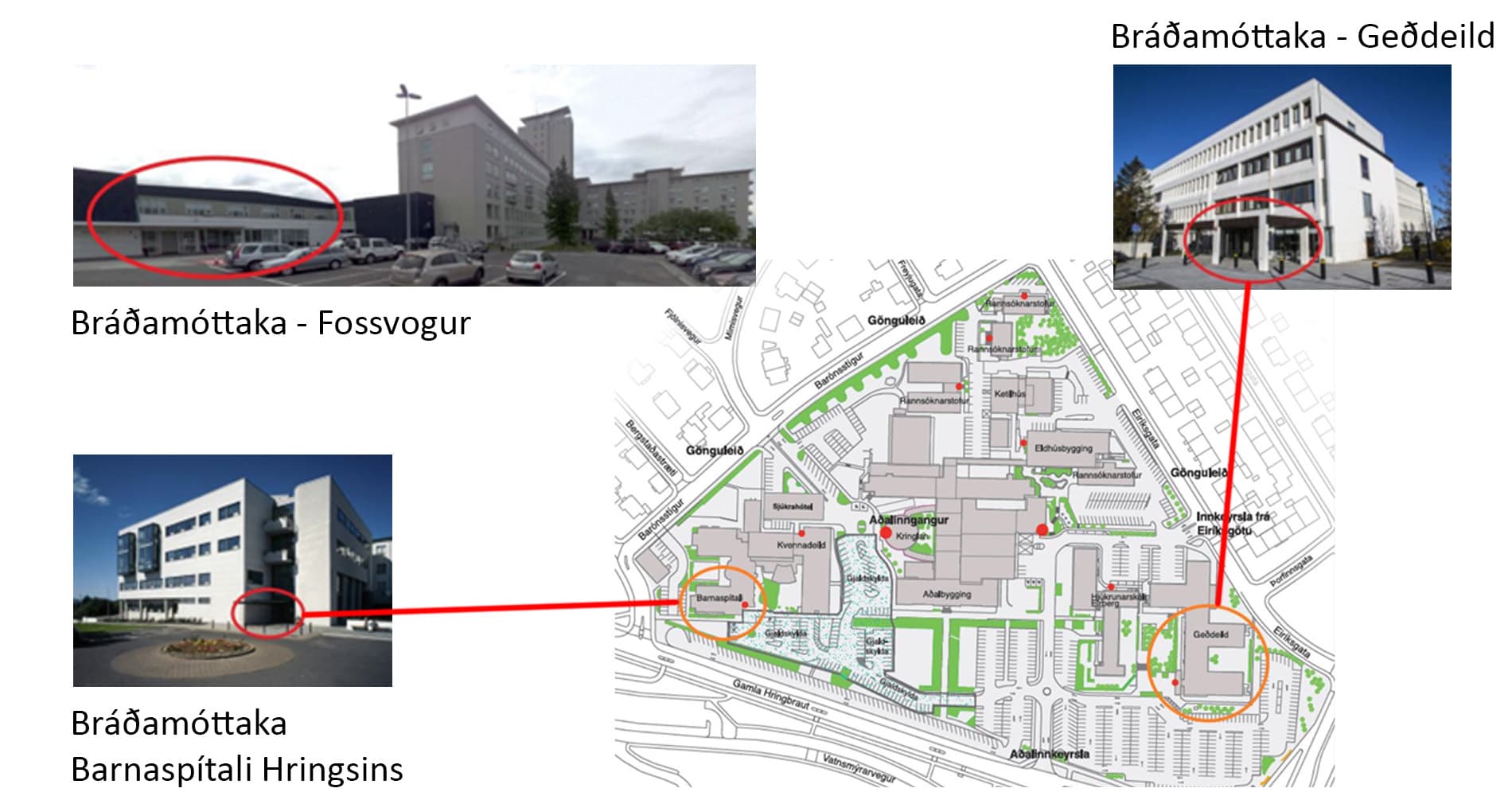
Bráðamóttaka in Fossvogur, see on Google maps.
Bráðamóttaka – Barnaspítali Hringsins (Childrens hospital), see on Google maps.
Bráðamóttaka – Geðdeild (mental health), see on Google maps.
Health and safety
The Emergency Line (Neyðarlínan) 112
- The telephone number in emergencies is 112. You use the same number in emergencies to contact the police, the fire brigade, an ambulance, search and rescue teams, the civil defence, child welfare committees and the Coast Guard.
- Neyðarlínan will try to provide an interpreter who speaks your language if this is considered urgently necessary. You should practise saying what language you speak, in Icelandic or English (for example, ‘Ég tala arabísku’; ‘I speak Arabic’) so that the right interpreter can be found.
- If you call using a mobile phone with an Icelandic SIM card, Neyðarlínan will be able to locate your position, but not the floor or room where you are inside a building. You should practise saying your address and giving details of where you are living.
- Everyone, including children, must know how to phone 112.
- People in Iceland can trust the police. There is no reason to be afraid of asking the police for help when you need it.
- For further information see: 112.is
Fire safety
- Smoke detectors (reykskynjarar) are cheap, and they can save your life. There should be smoke detectors in every home.
- On smoke detectors there is a small light that flashes regularly. It should do so: this shows that the battery has power, and the detector is working properly.
- When the battery in a smoke detector loses power, the detector will start to ‘cheep’ (loud, short sounds every few minutes). This means you should replace the battery and set it up again.
- You can buy smoke detectors with batteries that last up to 10 years.
- You can buy smoke detectors in electrical shops, hardware shops, Öryggismiðstöðin, Securitas and online.
- Do not use water to put out fires on an electric stove. You should use a fire blanket and spread it over the fire. It is best to keep a fire blanket on the wall in your kitchen, but not too close to the stove.
Traffic safety
- By law, everyone travelling in a passenger car must wear a seat belt or other safety equipment.
- Children under 36 kg (or less than 135 cm tall) should use special car safety equipment and sit in a car chair or on a car cushion with a back, with the safety belt fastened. Make sure you use safety equipment that suits the child’s size and weight, and that chairs for infants (under 1 year old) face the right way.
- The lifespan of most child car seats is 10 years, but infant car seats usually only last 5 years. The chair’s year of manufacture is stated on the bottom of the chair or on the manufacturer’s website. If a used car seat is bought or borrowed, it is important to check whether the seat has been damaged or dented.
- Children under 150 cm tall may not sit in the front seat facing an activated air bag.
- Children under 16 must use safety helmets when riding bicycles. Helmets must be the right size and properly adjusted.
- It is recommended that adults also use safety helmets. They give valuable protection, and it is important that adults should set their children a good example.
- Cyclists must use lights and studded tyres during the winter.
- Car owners must either use all-year tyres or change to winter tyres for winter driving.
Icelandic winters
- Iceland lies at a northerly latitude. This gives it bright summer evenings but long periods of darkness in winter. Around the winter solstice on 21 December the sun is only above the horizon for a few hours.
- In the dark winter months is important to wear reflectors (endurskinsmerki) on your clothes when you walk (this applies especially to children). You can also buy small lights for children to have on their school bags so they will be visible when they are walking to or from school.
- The weather in Iceland changes very quickly; winters are cold. It is important to dress properly for spending time outside and be prepared for cold wind and rain or snow.
- A woollen hat, mittens (knitted gloves), a warm sweater, a wind-proof outer jacket with a hood, warm boots with thick soles, and sometimes ice cleats (mannbroddar, spikes attached underneath shoes) – these are the things you will need to face Icelandic winter weather, with wind, rain, snow and ice.
- On bright, calm days in winter and spring, it often looks like nice weather outside, but when you go out you find it is very cold. This is sometimes called gluggaveður (‘window weather’) and it is important not to be fooled by appearances. Make sure you and your children are really well dressed before going out.
Vitamin D
- Because of how few sunny days we can expect in Iceland, the Directorate of Health advises everyone to take vitamin D supplements, either in tablet form or by taking cod-liver oil (lýsi). NB that omega 3 and shark-liver oil tablets do not normally contain vitamin D unless the manufacturer specifically mentions it in the product description.
- Recommended daily consumption of lýsi is as follows:
Infants over 6 months old: 1 teaspoon
Children aged 6 years and older: 1 tablespoon
- Recommended daily consumption of Vitamin D is as follows:
- 0 to 9 years: 10 μg (400 AE) per day
- 10 to 70 years: 15 μg (600 AE) per day
- 71 years and older: 20 μg (800 AE) per day
Weather alerts (warnings)
- On its website, https://www.vedur.is/ the Icelandic Meterological Office (Veðurstofa Íslands) publishes forecasts and warnings about the weather, earthquakes, volcanic eruptions and avalanches. You can also see there if the Northern Lights (aurora borealis) are expected to shine.
- The National Roads Administration (Vegagerðin) published information on the condition of roads all over Iceland. You can download an app from Vegagerðin, open the website http://www.vegagerdin.is/ or phone 1777 for up-to-date information before setting out on a trip to another part of the country.
- Parents of children in pre-schools (kindergarten) and junior schools (to age 16) should check weather alerts carefully and follow messages from the schools. When the Met Office issues a Yellow Warning, you must decide whether you should accompany (go with) your children to or from school or after-school activities. Please remember that after-school activities may be cancelled or end early because of the weather. A Red Warning means that no one should be moving about unless it is absolutely necessary; ordinary schools are closed, but pre-schools and junior schools stay open with minimum staff levels so that people involved in essential work (emergency services, the police, the fire brigade and search-and-rescue teams) can leave children in their care and go to work.
Earthquakes and volcanic eruptions
- Iceland lies on the boundary between tectonic plates and is above a ‘hot spot’. As a result, earthquakes (tremors) and volcanic eruptions are relatively common.
- Many earth tremors are detected every day in many parts of Iceland, but most are so small that people do not notice them. Buildings in Iceland are designed and built to withstand earth tremors, and most of the larger earthquakes occur far from population centres, so it is very rare that they result in damage or injury.
- Instructions for how to respond can be found here: https://www.almannavarnir.is/natturuva/jardskjalftar/vidbrogd-vid-jardskjalfta/
- There have been 46 volcanic eruptions in Iceland since 1902. The best-known eruptions that many people still remember were the ones in Eyjafjallajökull in 2010 and in the Vestmannaeyjar islands in 1973.
- The Met Office publishes a survey map showing the current status of known volcanos in Iceland Viðvörunarkort með núverandi ástandi eldstöðvakerfa á landinu, which is updated from day to day. Eruptions can result in lava flows, pumice and ash-falls with toxins (poisonous chemicals) in the ash, poison gas, lightning, glacial floods (when the volcano is under ice) and tidal waves (tsunamis). Eruptions have not often caused casualties or damage to property.
- When eruptions take place, it may be necessary to evacuate people from danger areas and keep roads open. This calls for a quick response by the civil defence authorities. In such a case, you must act responsibly and obey instructions from the civil defence authorities.
Domestic violence
Violence is illegal in Iceland, both in the home and outside it. All violence in a home where there are children also counts as violence against children.
For advice in cases of domestic violence, you can contact:
- The Social Services (Félagsþjónustan) in each municipal area.
- Bjarkarhlíð. https://www.bjarkarhlid.is/
- The Women’s Refuge (Kvennaathvarf) https://www.kvennaathvarf.is/
If you have received international protection through family reunification, but divorced your husband/wife on grounds of violent treatment, the Directorate of Immigration (Útlendingastofnun, UTL) can help you make a new application for a residence permit.
The Violence portal 112 www.112.is/ofbeldisgatt112 is a website operated by Iceland’s Emergency Line 112, where you can find a wide range of educational resources on different forms of violence, case studies, and possible solutions.
Violence against children
Everyone in Iceland has an obligation by law to notify the child protection authorities if they have reason to believe:
- that children are living in unsatisfactory conditions for their growth and development
- that children are exposed to violence or other degrading treatment
- that children’s health and development is being seriously endangered.
Everyone also has a duty, by law, to tell the child protection authorities if there is reason to suspect that the life of an unborn child is in danger, e.g. if the mother is abusing alcohol or taking drugs or if she is suffering violent treatment.
There is a list of the child welfare committees on the homepage of the The National Agency for Children and Families (Barna- og fjölskyldustofa): . https://www.bvs.is/radgjof-og-upplysingar/listi-yfir-barnaverndarnefndir/
You can also contact a social worker in the local Social Service centre (félagsþjónusta).
Emergency Reception for Victims of Sexual Violence (Neyðarmóttaka fyrir þolendur kynferðisofbeldis)
- Neyðarmóttaka fyrir þolendur kynferðisofbeldis The Emergency Reception Unit for Victims of Sexual Violence is open to everyone, without a referral from a doctor.
- If you want to go to the reception unit, it is best to phone first. The unit is in the hospital Landspítalinn in Fossvogur (off Bústaðarvegur). Phone 543-2000 and ask for the Neyðarmóttaka (Sexual Violence Unit).
- Medical (including gynaecological) examination and treatment
- Forensic medical examination; evidence is preserved for possible legal action (prosecution)
- Services are free of charge
- Confidentiality: Your name, and any information you give, will not be made public at any stage
- It is important to come to the unit as quickly as possible after the incident (rape or other attack). Do not wash before being examined and do not throw away, or wash, clothing or any other evidence at the scene of the crime.
The Women’s Refuge (Kvennaathvarfið)
Kvennaathvarfið is a refuge (a safe place) for women. It has facilities in Reykjavík and Akureyri.
- For women and their children when it is no longer safe for them to live at home because of violence, usually on the part of the husband/father or another family member.
- Kvennaathvarfið is also for women who have been raped or been trafficked (forced to travel to Iceland and engage in sex work) or exploited sexually.
- https://www.kvennaathvarf.is/
Emergency response telephone
Victims of violence/trafficking/rape and people acting for them can contact Kvennaathvarfið for support and/or advice at 561 1205 (Reykjavík) or 561 1206 (Akureyri). This service is open 24 hours a day.
Living at the refuge
When it becomes impossible, or dangerous, to go on living in their homes because of physical violence or mental cruelty and persecution, women and their children can stay, free of charge, at Kvennaathvarfið.
Interviews and advice
Women and others acting on their behalf can come to the refuge for free support, advice and information without actually coming to stay there. You can book an appointment (meeting; interview) by phone at 561 1205.
Bjarkarhlíð
Bjarkarhlíð is a centre for the victims of violence. It is on Bústaðarvegur in Reykjavík.
- Counselling (advice), support and information for victims of violence
- Coordinated services, all in one place
- Individual interviews
- Legal advice
- Social counselling
- Assistance (help) for victims of human trafficking
- All services at Bjarkarhlíð are free of charge
The telephone number of Bjarkarhlíð is 553-3000
It is open 8:30-16:30 Mondays-Fridays
You can book an appointment at http://bjarkarhlid.is
You can also send an e-mail to bjarkarhlid@bjarkarhlid.is
Various checklists
CHECKLIST: First steps after being given refugee status
_ Photograph for your residence permit card (dvalarleyfiskort)
- Usually restricted to non-Ukrainian nationals
- Photographs are taken at the ÚTL office or, outside the metropolitan area, at the local District Commissioner’s office (sýslumaður).
- ÚTL will send you a message (SMS) when your residence permit card is ready, and you can pick it up.
_ Open a bank account as soon as you have your residence permit card.
_ Apply for electronic identification (rafræn skilríki). https://www.skilriki.is/ and https://www.audkenni.is/
_ Apply for refugee’s travel documents
- If you cannot show a passport from your home country, you must apply for travel documents. They can be used in the same way as other personal ID documents like a passport which you need to apply for things like electronic identification (rafræn skilríki).
_ Contact the social services according to your domicile, there you can apply for financial assistance and social services.
- You can find information about the local authorities (municipalities) and their offices here: https://www.samband.is/sveitarfelog.
_ You can apply to the social services (félagsþjónusta) for assistance with rent and buying furniture and equipment
- Loan to pay a deposit on rented housing (leiguhúsnæði; apartment, flat)
- Furniture grant for essential furniture and household equipment
- Special housing benefit: Extra monthly payments to help with renting an apartment, in addition to regular housing benefit
- A grant to cover the first month’s expenses, since housing benefit is paid out afterward
- A grant, equivalent to full child benefit, to support you until the tax office will start paying full child benefit
- Special assistance is available for children, to cover costs such as pre-school fees, school meals, after-school activities, summer camps or leisure activities
- NB all applications are judged individually and you have to meet all the conditions set for receiving assistance.
_ You can book an appointment with a counsellor at the Directorate of Labour (Vinnumálastofnun,VMST)
- To get help with finding work and other ways of being active
- Registering for a course (lessons) in Icelandic and learning about Icelandic society
- Get advice about study (learning) together with work
- NB Job centre is open without appointments from Mondays to Thursdays from 13.00 to 15.00.
CHECKLIST: Finding a place to live
After you have been granted refugee status you may go on living in the accommodation (place) for people applying for international protection for only as long as two weeks more. Therefore it is important to look for somewhere to live.
_ Apply for housing benefits
_ Apply to the social services (félagsþjónusta) for assistance with rent and buying furniture and equipment
- Loan to pay a deposit on rented housing (leiguhúsnæði; apartment, flat)
- Furniture grant for essential furniture and household equipment.
- Special housing assistance Monthly payments on top of housing benefit, intended to help with renting an apartment.
- A grant to cover the first month’s expenses (because housing benefit is paid out retrospectively – afterwards).
_ Other assistance you can apply for through a social worker
- Study grants for people who have not finished compulsory school or upper senior school.
- Part-payment of the cost of the First Medical Check in out-patients infectious diseases departments of hospitals.
- Grants for dental treatment.
- Specialist assistance from social workers, psychiatrists or psychologists.
NB all applications are judged individually and you have to meet all the conditions set for receiving assistance.
CHECKLIST: For your children
_ Register in the online system of your municipality
- You need to register in your municipality’s online system, of your municipality such as Rafræn Reykjavík, Mitt Reykjanes, or Mínar síður on the Hafnarfjörður website, to enroll your children in school, school meals, after-school activities, and more.
_ Apply through a social worker for assistance for your children
- A grant, equivalent to full child benefit, to carry you through to the time when the tax office will start paying full child benefit.
- Special assistance for children, to cover costs such as pre-school fees, after-school activities, summer camps or leisure activities.
_ Apply to the Social Insurance Administration (TR; Tryggingastofnun) for financial support for single parents
- Information (in English) about child-support: https://island.is/en/child-support
- A request to TR for child-support payment is made through island.is: https://island.is/beidni-um-tr-milligangi-medlag
- Single parent allowance: https://island.is/en/single-parent-allowances